
The PPI Diplomate Program: A Three-Year Clinical Mastership Continuum
The Perio-Prosth Institute Diplomate Program is a cumulative, three-year professional development continuum designed exclusively for established private practitioners. This structured progression honors your current clinical experience while systematically elevating your diagnostic instincts to the highest level of contemporary dental practice.
By dividing the curriculum into distinct academic phases, we eliminate the primary failure of standard continuing education: fragmented, uncoordinated learning. To preserve high-intensity Socratic dialogue and collaborative peer calibration, each annual cohort is strictly limited to 24 attending clinicians. The program confers two credentials in sequence: Fellow of the Perio-Prosth Institute (FPPI) upon completion of Year 2, and Diplomate of the Perio-Prosth Institute (DPPI) upon successful defense of the Year 3 capstone case before PPI Faculty.
The Complete Curriculum Structure
Year 1: Foundational Frameworks
Module 101: 10-Week Live-Stream Term (Feb 23 - April 27, 2027)
Module 102: Immersive In-Person (June 25-26, 2027)
Module 103: Immersive In-Person (September 24-25,2027)
Year 2: Advanced Interactive Case Forums
Module 201: Immersive In-Person (Spring 2028)
Module 202: Immersive In-Person (Spring 2028)
Module 203: Immersive In-Person (Fall 2028)
Year 3: System Synthesis & Clinical Mastership Accreditation
Module 301: The Clinical Case Forum, In-Person (Summer 2029)
Module 302: Capstone Case Presentation, In Person (Fall 2029)
*PPI is an approved PACE provider. Module 101 provides 15 CE credits; each in-person module provides 16 CE credits.
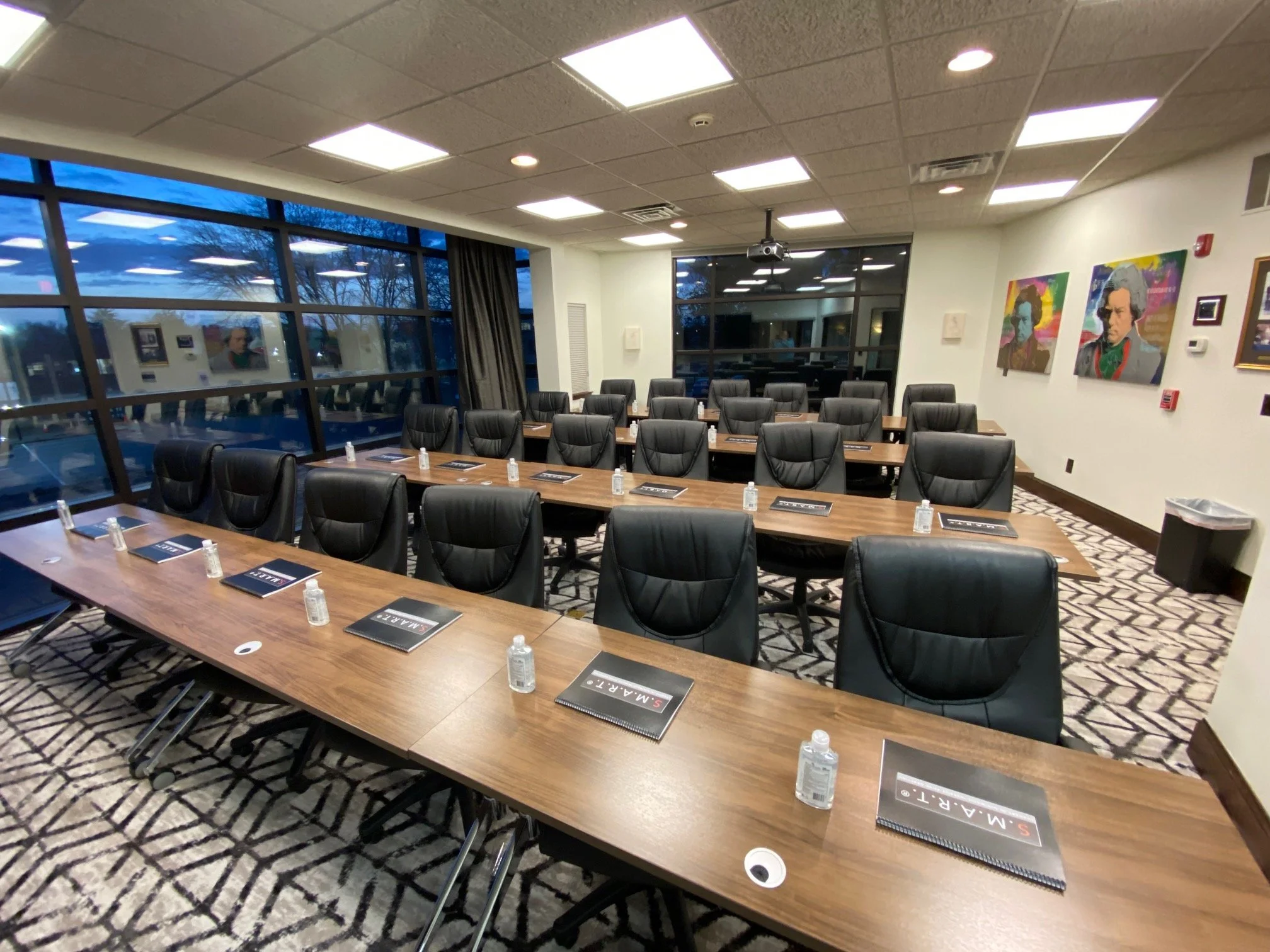
Our modern clinical boardroom—engineered specifically for intimate, Socratic case analysis and collaborative peer discussions.
Year 1: Foundational Literature and Diagnostics
Year One develops your baseline diagnostic fluency and introduces the PPI Face/Smile/Teeth diagnostic sequence, the analytic framework used throughout the curriculum. By dividing the first year into a winter digital term and two spring/fall in-person modules, you master the evidence at home before executing it live in the boardroom.
Module 101: Advanced Literature Sync
Ten weekly, 90-minute interactive live stream sessions from mid-January through March.
Format: Secure Interactive Live-Stream Boardroom seminars personally conducted by Dr. Lee.
The Focus: Evidence-Based Foundational Knowledge. Developing critical reading, critical observation and critical thinking skills.
The Process: These are not passive lectures. Literature is provided in advance to the doctors for their review, and Dr. Lee randomly calls on individuals to summarize or critique a publication during the seminar. Attendees will learn how to evaluate a scientific article and assess its clinical relevancy. Everyone should expect to be questioned and challenged in an environment of professional decorum.
Module 102: The Diagnostic Sequence — Meet the Face, Meet the Smile, Meet the Teeth — Part I
Two-day immersive on-site module (Friday–Saturday) in Bryn Mawr, PA. (Summer)
Facial Architecture: Mapping macro-facial landmarks, skeletal patterns, profile lines, structural asymmetry, and vertical dimension to determine maxillo-mandibular relations prior to any intraoral evaluation.
Soft-Tissue Dynamics: Evaluating smile line, phonetic boundaries, anterior tooth display, and mobile tissue transitions during active function to establish initial incisal edge positions.
Module 103: The Diagnostic Sequence — Meet the Face, Meet the Smile, Meet the Teeth — Part II
Two-day immersive on-site module (Friday–Saturday) in Bryn Mawr, PA. (Fall)
Biomechanical Stress Modeling: Predicting structural risk factors and force distribution on residual tooth structure or periodontally compromised roots to determine retention of natural teeth versus implant placement thresholds.
Tissue Interfaces: Surgical and restorative parameters of the periodontium, including supracrestal gingival complex dimensions, clinical crown lengthening, and mucogingival parameters vis-a-vis the need for additional exposure of tooth surfaces.
Alveolar Bone Foundations: Analysis of ridge preservation, primary stability metrics, bone grafting requirements, and immediate versus delayed implant placement criteria.
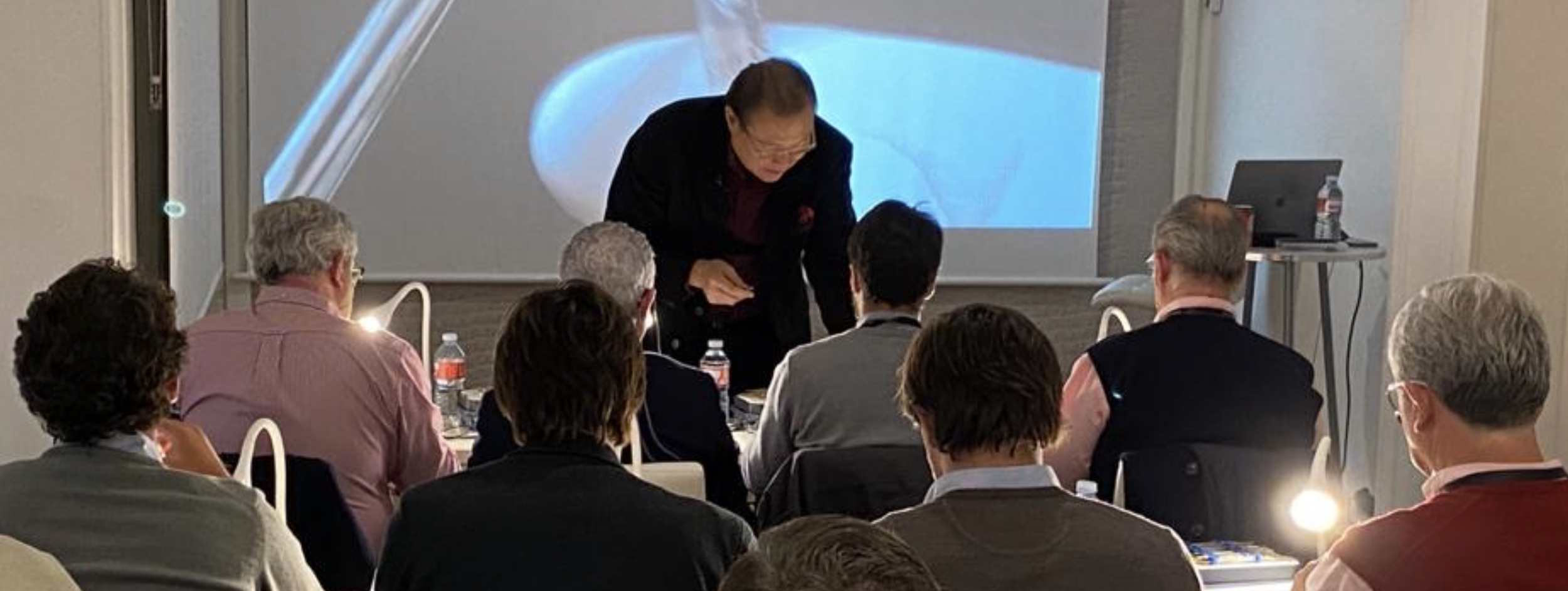
Dr. Ernesto Lee conducting a clinical hands on seminar for an international audience of practitioners in Madrid.
Year 2: Advanced Interactive Case Forums
Three immersive, two-day on-site modules (Friday–Saturday) in Bryn Mawr, PA.
Module 201: Advanced Esthetics and Smile Design (Spring)
Profile Mapping: Translating facial landmarks into precise incisal edge display parameters during active function.
The Gingival Interface: Customizing provisional restoration contours to dynamically sculpt mobile tissue, manage scalloped architecture, and eliminate black triangles.
Tooth Preparation Engineering: Reduction protocols to maximize ceramic structural strength while preserving vital tooth substrate and enamel bonds.
Module 202: Biomechanical Engineering and Full-Arch Occlusion (Spring)
Vertical Dimension Alterations: Rationale, criteria, and techniques for managing the OVD.
Reference Position Mapping (CR): Capture and registration of CR/RCP. Neuromuscular conditioning and biomechanical considerations.
Parafunction Management: Biomechanical engineering for the treatment and maintenance of the worn dentition.
Appliance Therapy: It’s role in diagnosis, treatment and prevention.
Perio-Prosth Occlusal Architecture: Design guidelines to manage non-axial loading.
Module 203: The Interdisciplinary Interface (Fall)
Adjunctive Orthodontic Frameworks: Forced eruption and orthodontic crown lengthening to alter soft-tissue levels, capture restorative ferrule, and regenerate bone structure.
Spatial Realignment: Root uprighting, molar intrusion, and space management. Achieving arch integrity and tooth positions conducive to insertion pathways for fixed prosthesis.
Treatment Sequencing: The chronological staging of complex cases—defining when to alter tissue, move teeth, engineer bone foundations, and transition into provisional stabilization.
*Disclaimer: The biological and biomechanical variables of complex reconstructions are inherently integrated. Because these interactive forums analyze actual clinical data from real patients, clinical realities will override rigid didactic boundaries. Topic overlap across modules is expected.
Year 3: System Synthesis & Clinical Mastership Accreditation
Two immersive in-person modules (Friday–Saturday) in Bryn Mawr, PA, focusing on the synthesis and presentation of real-world clinical cases.
Module 301: The Clinical Case Forum
Case Deconstruction: Clinicians present uncompromised diagnostic records from active cases within their own private practices following the PPI Face/Smile/Teeth sequence.
Calibration & Optimization: High-level peer review panel to audit proposed surgical and restorative sequences, identifying hidden biological or biomechanical risks prior to treatment execution.
Boardroom Dynamic: One clinician at a time presents their active practice case, followed by a moderated calibration session where colleagues and PPI Faculty act as peer reviewers to lock in diagnostic certainty.
Module 302: The Capstone Case Presentation
The Presentation Criteria: Delivery of a comprehensive, independent clinical presentation tracing a complex rehabilitation from macro-facial esthetics down to micro-granular support requirements.
Literature Alignment: Verification that every intervention selected is actively anchored in peer-reviewed scientific literature balanced against the clinical circumstances and practical realities of the case.
Credential Conferral: Successful completion of the case presentation, upon evaluation by the PPI Faculty, earns the designation: Diplomate of the Perio-Prosth Institute.
What the Diplomate of the Perio-Prosth Institute Signifies
Achieving the designation: Diplomate of the Perio-Prosth Institute certifies mastery of the system-centered diagnostic and therapeutic approach required to predictably execute complex rehabilitations. PPI Diplomates dissolve the artificial boundaries of fragmented continuing education, acquiring the clinical command and verified scientific rationale required to manage the mouth as a unified biological and biomechanical system.
The DPPI credential demonstrates to your peers, referral networks, and patients that the holder has trained under the historic Cohen-Amsterdam Periodontal Prosthesis lineage to conceptualize, present, and execute demanding complex reconstructions with confidence.
Fellow of the Perio-Prosth Institute (FPPI), conferred at the close of Year 2, recognizes completion of the program’s foundational and advanced case-forum curriculum. Diplomate status is reserved for those who complete the full three-year sequence and successfully defend a comprehensive case presentation before PPI Faculty in Year 3.
*Diplomate of the Perio-Prosth Institute and Fellowship of the Perio-Prosth Institute are credentials awarded by the Perio-Prosth Institute, a private continuing education provider, for completion of its educational program. Neither is a recognized specialty of the ADA or the Pennsylvania State Board of Dentistry, and neither constitutes board certification.
The Perio-Prosth Institute has no affiliation with the University of Pennsylvania or Penn Dental Medicine. Any Penn references are historical